




it’s a new day. see it clearly.


Johnson Laser eye

Cataract Surgery In Wilmington

What Is a Cataract and How Does It Affect Vision?
Think of your eye like a camera. Inside every eye sits a natural lens that allows you to focus on the world around you. When you are young, this lens is crystal clear and remarkably flexible. Over time, however, the eye’s natural lens gradually begins to stiffen and cloud over. This aging process typically begins in your early 40s, when the first symptoms start to appear.
If you have noticed decreased near vision, a shrinking range of focus, or a growing dependence on reading glasses or bifocals, you are already experiencing the early stages of natural lens aging. Eventually, the lens does not just stiffen. It becomes progressively cloudy, causing poor vision that can no longer be corrected with glasses or contact lenses. This clouded lens is what we call a cataract, and when it begins to interfere with daily life, the right solution is to replace it with a brand-new, clear artificial lens through cataract surgery. Conditions such as diabetes can accelerate this process. Patients with diabetic retinopathy, for example, are at elevated risk for earlier or more complex cataract development, making regular eye health monitoring especially important.
When the clouding becomes significant enough to interfere with daily life, the right solution is to replace the cloudy lens with a brand-new, clear artificial lens through cataract surgery.
At Johnson Laser Eye, Dr. Johnson has helped hundreds of Wilmington patients rediscover clear, vibrant vision. With nearly two decades of local experience and a reputation as the ophthalmologist other Wilmington doctors trust with their own families’ eyes, you are in highly skilled and genuinely caring hands.
Symptoms of Cataracts: When to See an Eye Surgeon
Many people are surprised to learn how gradually cataracts develop and how significantly they can affect vision before a person realizes surgery may be the answer. We recommend scheduling a consultation with our eye surgeon, Dr. Johnson, if you are experiencing any of the following:
- Blurred vision or blurry vision that glasses no longer fully correct
- Glare, particularly at night or around bright lights
- Ghost images or double vision
- Decreased contrast sensitivity, meaning difficulty seeing sharp outlines of objects
- Colors appearing dull or washed out
- Halos around lights
- Increased sensitivity to bright light
Blurred vision is one of the most common early warning signs, but because it develops slowly, many patients assume it is simply a matter of needing a stronger glasses prescription. If your vision has been gradually worsening despite updated lenses, cataracts may be the underlying cause. Do not wait to have your eyes evaluated. Cataracts are progressive, and early consultation gives you and Dr. Johnson the best opportunity to plan an outstanding outcome.
How Cataract Eye Surgery Works: Phacoemulsification Explained
Cataract surgery is one of the most commonly performed, predictable, and successful procedures in all of medicine. As a same-day outpatient procedure, patients arrive at our Wilmington facility, have their surgery performed by Dr. Johnson, and return home within a matter of hours. The technique used at Johnson Laser Eye is called phacoemulsification cataract surgery, the gold standard approach used by leading eye surgeons around the world.
During phacoemulsification cataract surgery, Dr. Johnson makes a tiny incision in the eye and uses ultrasound energy to gently break up and remove the cloudy natural lens. Once cataract surgery removes the damaged lens, it is replaced with a precisely selected intraocular lens (IOL), an artificial lens engineered for long-term clarity. The eye’s natural lens capsule is preserved to cradle and support the new implant.
This procedure is also known as refractive lens exchange when performed in patients who want to address focusing problems before cataracts become advanced. Either way, cataract surgery removes the source of visual decline and can significantly reduce dependence on glasses or contact lenses, depending on the lens selected.
If cataracts affect both eyes, surgery on each eye will be scheduled on two separate days to allow for proper healing in between.
Following surgery, Dr. Johnson will prescribe eye drops to prevent infection and support healing. You will need to wear a protective eye shield and avoid strenuous activity during the early recovery period.
Why Eye Health and Overall Health Matter Before Surgery
Your overall eye health plays an important role in the cataract surgery planning process. During your pre-operative evaluation, Dr. Johnson will assess not only your cataracts but also the broader condition of your eyes. Patients managing systemic conditions like diabetes require particular attention, as diabetic retinopathy or other diabetes-related changes can affect vision outcomes after surgery. Conditions such as glaucoma, macular degeneration, and dry eye disease are also factored into lens recommendations and surgical planning.
Knowing your complete eye health picture allows Dr. Johnson to set accurate expectations, choose the most appropriate IOL, and take any additional steps that will give you the best possible results. No detail is too small when it comes to your vision.

Cataract Surgery Lens Options at Johnson Laser Eye
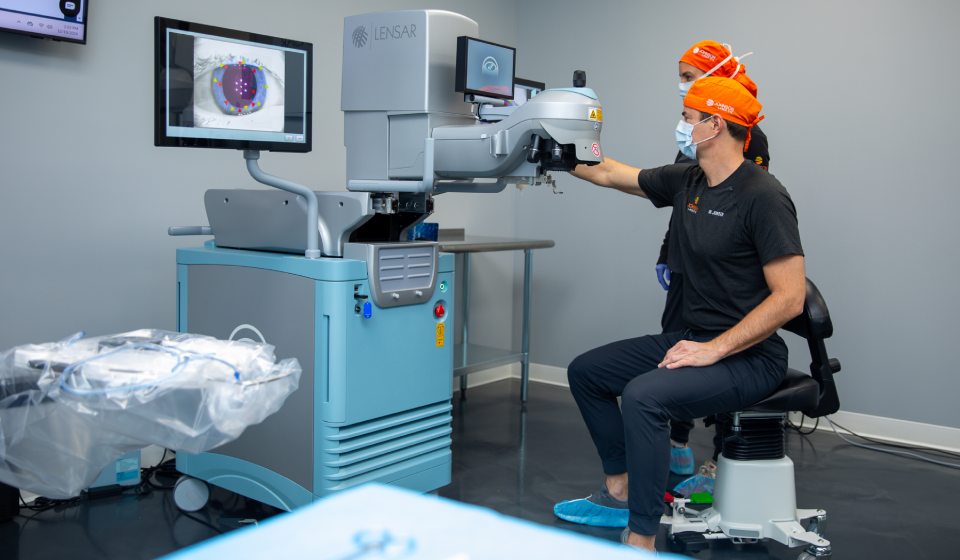
Since the early 1980s, placing an artificial lens after cataract removal has been standard practice. Today, patients have access to a remarkable range of Advanced IOL options capable of correcting vision across multiple distances and reducing or eliminating astigmatism. At Johnson Laser Eye, the ALLY Adaptive Laser Cataract system allows Dr. Johnson to fine-tune Advanced IOL placement with exceptional precision.
Basic Intraocular Lens (IOL)
The standard monofocal lens is covered by Medicare and most commercial insurance plans. With a basic IOL, your vision after cataract surgery will be meaningfully improved compared to before, but you will likely still need glasses for near, intermediate, and potentially distance tasks, since monofocal lenses do not correct astigmatism. This is a reliable, well-established option for patients whose primary goal is simply clearer distance vision with insurance coverage.
Multifocal IOL (Distance, Intermediate, and Near Vision)
Multifocal lenses are designed to give you functional, clear vision at all distances with minimal reliance on glasses or contacts. These lenses offer the greatest potential for visual freedom after cataract surgery and can correct astigmatism at the same time. Some patients notice glare or halos around lights during the adjustment period, though this typically improves over time. Multifocal lenses deliver especially precise results when fine-tuned with the ALLY Adaptive Laser Cataract system.
Extended Depth-of-Focus IOL (Distance and Intermediate Vision)
Extended depth-of-focus, or EDOF, lenses are a popular choice for patients who want excellent all-around vision quality without the night-glare sensitivity that some associate with multifocal lenses. Most distance and intermediate activities, from driving to working on a computer, can be performed without glasses. Reading glasses may still be needed for small print or close-up tasks in dim lighting. EDOF lenses can also correct astigmatism.
Astigmatism-Correcting Toric IOL
Toric lenses are the ideal cataract surgery choice for patients with astigmatism who want sharp, clear distance vision and do not mind using reading or computer glasses for close work. Toric IOLs are also a strong option for patients interested in blended vision, where one eye is optimized for distance and the other for intermediate or near tasks. Toric IOL placement is significantly enhanced by the ALLY Adaptive Laser Cataract system.
Why Choose Johnson Laser Eye for Cataract Surgery in Wilmington?
Nearly Two Decades of Local Trust. Dr. Johnson has spent close to 20 years building a reputation in Wilmington as the eye surgeon other physicians refer their own patients and families to. That trust is earned one patient at a time.
Advanced Technology. From comprehensive pre-operative diagnostic imaging to the ALLY Adaptive Laser Cataract system, Johnson Laser Eye invests in the technology that produces the best outcomes.
Truly Personalized Care. Your cataract surgery plan is built around you, not a template. Dr. Johnson takes the time to understand your lifestyle, visual goals, and priorities before making a lens recommendation.
On-Site Office-Based Surgery. Having your procedure performed in our own surgery suite means you are surrounded by familiar staff in a calm, welcoming setting. There is no need to navigate a hospital.
Long-Term Commitment to Your Vision. Our relationship with you does not end on surgery day. Dr. Johnson and the Johnson Laser Eye team are here for you for years to come.

CATARACT SURGERY FAQ
What happens during the pre-operative visit?
We use the world’s most advanced diagnostic technology to get an incredibly detailed map of your eyes from front to back. These tests are painless – mostly just a series of quick flashes of bright lights. We will then dilate both eyes with eye drops (after which time your vision might be a little blurry for a few hours, especially up close). Dr. Johnson will then personally examine your eyes and discuss cataract surgery with you in detail. Finally, you will have an opportunity to meet with our Patient Concierge, who will assist with surgical scheduling, insurance, financing, forms, etc.
There are so many lens implant options! How do I decide which is right for me?
It’s true that there are a lot of lens implant options available, and we employ a wide variety based on the needs and desires of each individual patient. First, we really want to understand who YOU are – your interests, your priorities and your goals. We then analyze the information obtained through advanced diagnostic testing and a careful exam. Based on all of this information, Dr. Johnson will make a specific recommendation from a narrowed-down number of lens options. From here, it’s a conversation leading to the selection of a lens we’re both really excited about. Ultimately, we share the same goal – amazing new vision for both of your eyes! We’ll get there together.
What happens if the lens implant option I select doesn’t work out well for me?
In the unlikely event that your vision doesn’t turn out like we wanted, there are still options for getting great vision. Sometimes we can leave the lens implant in place and make other adjustments to your vision. An example of this might be a laser tune-up. Some lenses can take several months to fully adapt, particularly multifocal lenses, so often the best solution is to just give things a little more time, with great vision waiting down the road a little ways. Other times the best option is to exchange the implant for a different type. Regardless of the situation, we try to do all the work before surgery, so that we have the highest possible chance of an amazing outcome.
Why doesn’t Medicare or my other insurance cover Advanced IOL’s or Laser Cataract Surgery with astigmatism correction?
Insurance companies have their own reasons for what they will and will not do, but usually it comes down to $$. It has nothing to do with how well these technologies work, it’s just that insurance companies such as Medicare have decided they don’t want to pay for anything more than the basic option.
Is an Advanced IOL and Laser Cataract Surgery affordable?
We offer a variety of easy payment plans to make Advanced IOL’s and/or Laser Cataract Surgery with astigmatism correction very affordable for most budgets. Our Patient Concierge will review these options in detail on the day of your consultation.
What happens on surgery day? What is the surgery itself like?
When performed in our Office-Based Surgery facility, right here at Johnson Laser Eye, the cataract surgery experience should feel very smooth and relaxed. You’ll be taken care of by the same staff whom you have already come to know from prior visits to our office. We will give you medicine to help you relax before surgery, then escort you into our world-class cataract surgery suite. If your surgery is performed at the Ambulatory Surgery Center, it will feel a little more like a hospital environment, but you’ll still be extremely well cared for by the Wilmington SurgCare staff. During the surgery, you’ll see some bright lights and you might sense a little fluid or gentle pressure. Dr. Johnson will talk you through the procedure, and before you know it, you’ll be finished and on your way home!
Does it hurt?
No. Cataract surgery is not painful.
What happens after surgery?
You’ll be on your way home shortly after the conclusion of your surgery. Your eye will be covered with a protective shield, and you’ll start using your eyedrops later that same day. Most patients need to use their drops for about a month after surgery. Dr. Johnson will check your eye the day after surgery, and then you’ll have another post-op visit one week after surgery and one month after surgery, either at Johnson Laser Eye or with your regular eye doctor.
What can I do or what should I avoid after surgery?
For the first few days after surgery, you should take it easy and avoid strenuous activity. At your one week checkup, you will likely be cleared to resume most regular activities. You can usually start driving again and return to work as soon as you are comfortable doing so, often 2-3 days after surgery.
How soon does my vision improve?
This depends on a lot of individual factors, such as the density of the cataract or other conditions such as glaucoma or macular degeneration. That said, most patients will see a significant improvement in their vision between 1 and 7 days after surgery.
Do cataracts come back?
A cataract is when your own natural lens becomes clouded, and during surgery this cloudy lens is completely removed and replaced with an artificial lens. So the cataract cannot come back, ever. What does happen commonly is that the body can develop some film behind the lens implant, which can make the vision blurry again. Fortunately, this film is easily treated with an in-office procedure called a YAG laser. This painless treatment takes less than a minute, and is covered by insurance.
What are the risks?
Cataract surgery is one of the most commonly performed, safest, and predictable procedures in all of medicine, but like any surgery, it is not risk-free. From time to time, unfavorable things DO happen during or after cataract surgery, and fortunately, most (but not all) can be managed with a good final outcome. Risks include, but are not limited to, infection, bleeding, glaucoma (elevated eye pressure), dry eye, inflammation or swelling, double vision, droopy eyelid, floaters, retinal detachment, the need for additional surgery, or even blindness.
Have I selected the right surgery center? The right doctor?
Well, we certainly think so! At Johnson Laser Eye, we use the world’s most advanced technology, while treating all of our patients with the highest level of kindness and respect. Dr. Johnson has developed a reputation over nearly 2 decades in local practice as the Wilmington ophthalmologist other doctors trust with the eyes of their patients and their own families. We consider it an honor and a privilege for you to consider Johnson Laser Eye for your cataract surgery.
Will I be left high and dry after surgery?
Certainly not. We are always here for you, for as long as you need us. You can call Dr. Johnson 5 or even 10 years after your surgery, and he will always be happy to help.
Will all of my questions be answered?
Yes! Ask all of them, and then ask them all again if needed. We love what we do and are always happy to talk about cataract surgery.
Will they think my questions are dumb?
No, there truly are no silly questions. If you’re thinking it, chances are someone else is too. Ask away! We want you to be fully informed and confident in your eye care decisions.
Is there anything else I should know?
Modern cataract surgery is truly life-changing, and we welcome the opportunity to assist you in exploring the possibilities. We would love to meet you and learn about your eyes, your lifestyle, and your goals, and in doing so, to earn your trust in this journey.